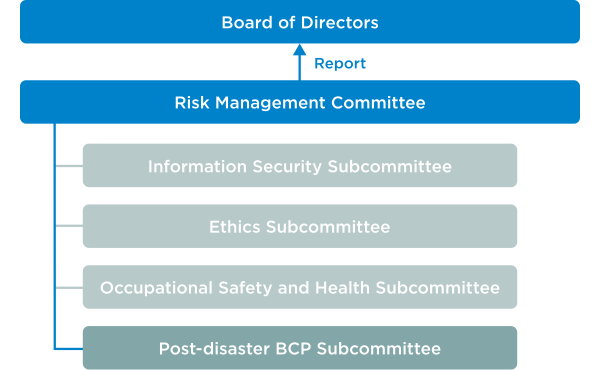
Forecasts in recent years have indicated that there is a high possibility of a major earthquake occurring—e.g., epicentral earthquake in Tokyo, Nankai Trough Mega Earthquake. In addition, climate change caused by global warming tends to increase the frequency and severity of typhoons and other natural disasters. The Nissui Group has established the "Post-disaster BCP (Business Continuity Planning) Subcommittee" under the Business Foundation Risks Committee and is reinforcing its structure to deal with ever-increasing uncertainties.
In the Nissui Group, we will promote our business continuity plan in accordance with the following policy in order to continue providing necessary assistance, services, etc., for our employees, customers and stakeholders even in the event of a major disaster by giving top priority to human life.
If a disaster is expected to occur or has occurred, the Nissui Group will set up a local disaster response office at the expected/actual disaster location and establish a disaster management headquarters at Nissui's head office (or a backup location if its head office cannot be used) as the Group's central function, and promptly collect information and take action by collaborating with those at the site and Group companies.
In order to facilitate activities as an organization in the event of a disaster, the Nissui Group will periodically conduct education and training, and also perform inspections and make improvements aimed at developing its structure, and thereby boost its ability to continue business.
Enactment Date: April 2020
The Post-disaster BCP Subcommittee, set up under the umbrella of the Business Foundation Risks Committee with the aim of development of a disaster BCP framework for Nissui and its Group companies in Japan, convenes four times a year and is chaired by an Executive Officer appointed by the Business Foundation Risks Committee.
Specifically, the subcommittee is promoting the transition to an all-hazard BCP, which flexibly responds to any crisis event, through the revision of the initial response manual to increase effectiveness in the event of a disaster, the establishment and operation of an information collection system to immediately visualize damages to business locations in the event of a disaster, and the implementation of business impact analysis (BIA) to clarify the priorities for business continuity. Furthermore, the subcommittee conducts a quantitative assessment of natural disaster risks at the same time to analyze and understand the impact of potential risks on management from multiple perspectives. In this way, the subcommittee is working to build a more robust organizational structure and improve resilience.
Nissui has organized responses to be taken in the event of a major disaster into phases and clarified roles and actions at each phase. Immediately after the occurrence of a disaster, the first priority is to ensure safety through individuals’ own effort. Subsequently, the disaster management headquarters will collect information and make decisions. At each business, responses will be taken to continue and restore the business. These initiatives have been established in the form of manuals.
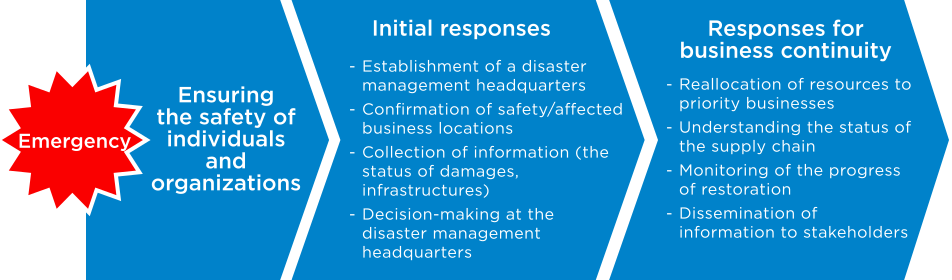
In the event of a major disaster, a disaster management headquarters will be established, headed by the President and consisting of officers and the head of each business. The disaster management headquarters will assess the status of damages and decide on response policies. At Nissui’s each business location, a local disaster management headquarters, led by the person in charge of the business location, will be established to promptly share information and take responses in cooperation with the headquarters.
We conduct a drill at the disaster management headquarters once a year, with the participation of all Executive Officers, to increase the effectiveness of our responses in the event of a disaster. The drill is conducted assuming a variety of circumstances, including holidays and remote environments. As internal education, we provide support to increase the effectiveness of drills at business locations, and conduct system operation verification drills and disaster prevention e-learning course for employees in order to strengthen initial response capabilities.
A safety confirmation system is a mechanism by which a company promptly identifies whether or not its employees and their families are safe primarily based on a scenario in which a huge earthquake with a maximum seismic intensity of "5 Upper" or higher on Japan Meteorological Agency's Seismic Intensity Scale has occurred. Once a year, employees check that their contact details and other information registered in the system are up to date and engage in a reporting drill according to the actual flow. Since introducing this system, we have been able to confirm the safety of employees and their families in a short period of time when an earthquake has actually occurred, thanks to the system functioning effectively.
An e-learning course targeted at all employees of Nissui Corporation is conducted for the purpose of raising their awareness of disaster prevention and checking their initial responses in the event of a disaster.
In the e-learning course conducted in August 2023, the content focused on improving employees’ ability to respond during disasters and enhancing their awareness of disaster prevention by: (i) gaining general knowledge of disaster preparedness and initial actions; (ii) understanding and verifying communication methods during a disaster; and (iii) ensuring familiarity with the “Basic Policy for Post-disaster BCP.” The course had a participation rate of 94.5%. Also, we sent study materials to employees who had not taken the e-learning course to help them catch up on the course.